



Title: The Last Letter from Lisbon
Author: jeff meridian
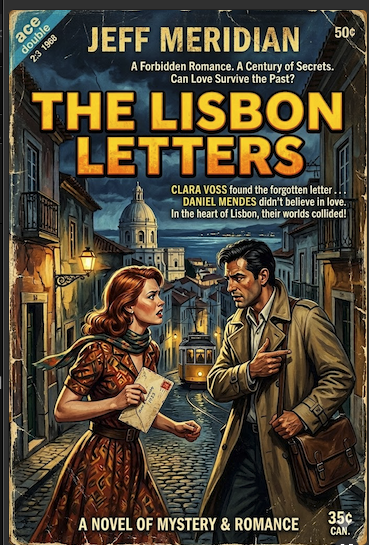
The Letter in the Wall #
The wrought-iron gates groaned as Clara pushed them open, their hinges protesting with a sound like a held breath finally released. The estate loomed ahead, its once-proud façade now softened by time, peeling stucco, shutters hanging at odd angles. The morning air carried the scent of wet stone and something older, something like the pages of a book left too long in the rain. She adjusted the strap of her satchel, her fingers brushing the edge of the letter in her pocket, its corners sharp against her palm.
The driveway was a mess of cracked cobblestones, each step sending a jolt through her heels. The fog hadn’t lifted yet, clinging to the walls like a second skin. It muffled the sound of her footsteps, made the estate feel smaller, more intimate. She paused at the threshold, running her fingers along the doorframe. The paint was rough under her touch, flaking away in thin strips. Someone had carved initials into the wood, A.V. and R.M., the edges worn smooth by years of hands brushing past. Clara traced them, her pulse quickening. The letter s in her pocket suddenly felt heavier.
Inside, the house swallowed the sound of her entrance. The air was thick with dust motes, drifting lazily in the slanted morning light. The library stretched before her, a cavern of forgotten things. Shelves sagged under the weight of leather-bound volumes, their spines cracked, their pages yellowed. A ladder leaned against one wall, its rungs worn smooth by generations of hands. Clara set down her satchel, her breath steady, but her fingers trembled as she reached for the first book. The light through the grimy windows cast long, uneven stripes across the floor, like bars of gold cutting through the gloom.
She began her inventory, methodical as always. Title, condition, notes on preservation. But her mind kept drifting to the name in the ledger, Rafael Mendes, and the way the ink had bled just slightly, as if the writer had hesitated before pressing the pen to paper. The letter s in her pocket burned. She could feel the weight of them, the promise of something unspoken. A loose panel behind a shelf of 19th-century poetry caught her eye. It was slightly askew, the wood warped with age. Clara knelt, prying it free with a letter opener. The hollow space behind it was dark, but her fingers found the bundle immediately, a stack of letter s tied with frayed ribbon, the top one addressed in ink that had blurred with time: Minha Querida Ana.
Her breath hitched. The paper was brittle, the edges frayed. She unfolded it carefully, the creases threatening to split under her touch. The date, 12 de Outubro, 1923, and the signature, R.M., leapt out at her. The words described a meeting at a café near the river, a promise whispered in the dark, a love that had no place in the world. Clara read it twice, three times. The letter had never been sent. The realization settled in her chest like a stone. She checked the estate’s ledger, flipping through the pages until she found it: Rafael Mendes , best friend of the late owner, last seen 1924. The entry was brief, almost dismissive, as if the writer had been in a hurry to forget.
Outside, the wind rattled the shutters , and for a moment, Clara imagined a shadow lingering in the doorway, watching her. She shook the thought away, but not before slipping the unsent letter into her pocket, where it pressed against her ribs like a live coal. The rest of the bundle she tucked into her bag, her movements quick, almost guilty. The photograph in the ledger caught her eye, a young man with sharp cheekbones and a smile that didn’t reach his eyes. The resemblance was unmistakable. She had seen him earlier, standing across the street, his gaze fixed on the estate. Clara didn’t know his name yet, but she knew she would. The letter s in her bag felt like a secret she wasn’t meant to keep.
The ledger’s spine cracked as Clara closed it, the sound sharp in the quiet of the study. The name * Rafael Mendes * lingered in the margin, the ink smudged as if someone had traced it repeatedly, pressing too hard. She exhaled through her nose, the air warm against her lips, and reached for the telephone on the desk. The cord coiled like a sleeping snake, dust clinging to its plastic ridges. Her fingers hovered over the dial before landing on Isabel’s number, the digits worn smooth from use.
The line rang once, twice . Then, "Clara? You’re calling early. Did you finally find a book with a happy ending?" Isabel’s voice spilled into the room, bright and teasing, but Clara didn’t smile. She pressed the receiver tighter to her ear, her free hand gripping the edge of the desk.
"I found something," she said. The words came out steady, but her thumb tapped against the wood, a nervous rhythm. "A name. Rafael Mendes ."
Silence. Not the kind that meant Isabel hadn’t heard, but the kind that meant she had. "Ah," she said at last, the syllable stretching like taffy. "That name’s got weight in this city."
Clara’s pulse thrummed in her throat. "What kind of weight?"
Isabel sighed, and Clara could picture her leaning back in her chair, the way her bracelets would clink against the armrest. "Old. Complicated. His grandson teaches at the university, Daniel Mendes. Specializes in colonial archives, if I remember right." A pause. "Why?"
Clara traced the edge of the letter in her pocket, the paper crinkling under her touch. "I need to talk to him."
"You sure about that?" Isabel’s voice dropped, the warmth replaced by something sharper. "Some stories aren’t meant to be poked at, Clara. Some doors don’t open from the outside."
Clara swallowed. "I’m not poking. I’m, " She stopped. What was she doing? Unburying a love that had been left to rot? "I just need to know."
Isabel made a noise, half-laugh, half-sigh. "Of course you do." A beat. "Daniel’s office is in the old faculty building. But Clara, "
Clara hung up before she could finish. The dial tone buzzed in her ear, a flat, insistent sound. She set the receiver down with care, as if it might shatter, and turned back to the ledger. The photograph was still there, tucked into the crease of the page. She pulled it free, the edges rough under her fingers. The man in the image stared back at her, his face all sharp angles and unsmiling eyes. The resemblance to the figure she’d seen earlier, standing across the street, hands in his pockets, watching the estate, was unmistakable.
She slipped the photograph into her bag alongside the letter s, the weight of them pressing against her hip. The study suddenly felt too small, the air thick with the scent of old paper and something else, something like damp earth, like a grave freshly turned. Clara gathered her things quickly, her movements precise, efficient. The letter in her pocket burned against her ribs, a secret she wasn’t ready to share.
Outside, the wind had picked up, rattling the shutters like impatient fingers. She stepped into the hallway, the floorboards groaning under her weight, and pulled the door shut behind her. The lock clicked into place with finality. For a moment, she stood there, listening to the silence of the house, the way it seemed to hold its breath.
Then she turned and walked away, the letter s in her bag feeling less like a discovery and more like a debt.
The photograph lay face-down on the ledger’s open page, its edges curled with age. Clara turned it over. The man in the image wore a high-collared coat, the fabric dark against the sepia tones, his posture rigid as if bracing against an unseen wind . His eyes, sharp, almost defiant, held something she couldn’t name. A warning, perhaps. Or an invitation. She traced the line of his jaw with her fingertip, the paper rough beneath her skin. The resemblance to the figure outside was undeniable: the same sharp cheekbones, the same set of the mouth, though the man across the street had looked at her with something closer to calculation than the ghost of a smile in this photograph .
She slipped the image into her bag, the weight of it settling against the letter s like a counterbalance. The study’s silence pressed in, broken only by the creak of the floorboards as she shifted her weight. The air smelled of ink and dust, the kind of scent that clung to the back of the throat. She exhaled, slow and deliberate, then reached for the phone. The dial tone hummed in her ear, steady and unyielding.
Isabel answered on the third ring, her voice warm with the kind of laughter that suggested she’d been mid-sentence when she picked up. “Clara! You’ve only been there a day and already you’re calling me like a woman possessed.”
Clara’s fingers tightened around the receiver. “I found something.”
A pause. Then, quieter, “Of course you did.”
The words hung between them, heavy with implication. Clara could picture Isabel leaning back in her chair, her office wind ow framing the same rooftops Clara had glimpsed from the estate’s upper floors. “It’s about the Mendes family,” she said, keeping her voice even. “I need a name.”
Isabel’s breath hitched. “Clara.”
“Just a name.”
Another silence, longer this time. Clara could hear the rustle of papers, the distant chime of a clock. “Daniel Mendes,” Isabel said at last. “He’s a historian. Works at the university. Specializes in, ” She cut herself off. “But Clara, this isn’t some romantic mystery you can unravel in an afternoon. These people have roots here. They don’t just hand out their secrets.”
Clara didn’t answer. The letter s in her bag seemed to pulse against her hip, their edges digging into her skin. She could feel the weight of Rafael’s unsent words, the way they’d pressed against her ribs since she’d first unfolded them. “I need an address.”
Isabel sighed, the sound crackling through the line. “Clara, ”
She hung up before the warning could take shape.
The ledger lay open on the desk, Rafael’s name scrawled in the margin like an afterthought. Clara stared at it, her reflection warped in the polished wood. The photograph in her bag felt heavier now, its secrets pressing against the fabric. She reached for the letter s, her fingers brushing the frayed ribbon, then hesitated. The unsent one, Minha Querida Ana, burned in her pocket, its edges sharp against her thigh.
Outside, the wind rattled the shutters , a sound like bones knocking together. For a moment, she imagined Rafael standing in the doorway, his coat damp with rain, his eyes fixed on the letter s in her hands. She shook the thought away, but the chill lingered.
She gathered her things quickly, her movements precise. The photograph went into her bag. The letter s followed, their weight familiar now, almost comforting. The unsent one stayed in her pocket, its presence a quiet rebellion. She zipped the bag shut, the sound too loud in the stillness, then turned toward the door.
The hallway stretched before her, the floorboards groaning under her heels. The house seemed to exhale as she stepped into the light, the scent of old paper clinging to her skin like a second shadow. She didn’t look back.
The ledger lay open on the desk, its pages brittle as autumn leaves. Clara’s fingers hovered over the name, * Rafael Mendes *, scrawled in the margin, the ink faded to the color of old tea. She traced the letter s, her breath shallow. The photograph beside it was small, the edges curled, but the face was clear: a young man with sharp cheekbones, his mouth set in a line that wasn’t quite a smile. The same face she’d seen outside, across the street, watching.
Her phone buzzed in her pocket. She ignored it.
The study smelled of time and neglect, the air thick with dust motes that caught the light like scattered stars. The letter s were spread before her now, their edges frayed, their words pressing against the silence. She picked up the unsent one, the paper rough under her fingertips. Minha Querida Ana. The ink had bled in places, as if Rafael had hesitated, his pen lingering too long. She wondered if he’d torn it up afterward, if he’d burned it, if he’d ever meant to send it at all.
The phone rang again . Isabel’s name flashed on the screen.
Clara answered, her voice steadier than she felt. “I found something.”
Isabel’s laugh was warm, a sound like wind through dry grass. “Of course you did.” A pause. “You’re calling about the letter s, aren’t you?”
Clara’s grip tightened on the phone. “Do you know who Rafael Mendes was?”
Another pause. Longer this time. “They’re old Lisbon,” Isabel said carefully. “The family’s been here for generations. Why?”
Clara didn’t answer. Instead, she asked for a name. An address.
Isabel sighed. “Daniel Mendes. Historian. Works at the university.” A beat. “But Clara, ”
Clara hung up before she could finish.
The name settled over her like a weight. Daniel Mendes. The man from the street. The grandson of the man who had written these letter s, who had loved her great-grandmother and never sent his words. She stared at the photograph again, at the way his eyes seemed to follow her, even in stillness.
The letter s felt heavier now, their secrets pressing against her skin. She tucked them into her bag, one by one, but the unsent one she kept out, slipping it into her coat pocket. It burned against her ribs, a live coal.
Outside, the wind rattled the shutters , a sound like bones knocking together. For a moment, she imagined Rafael standing in the doorway, his coat damp with rain, his eyes fixed on her. She shook the thought away, but the chill lingered.
She gathered her things, her movements precise, deliberate. The photograph went into her bag last, tucked beside the letter s. The ledger she left open on the desk, Rafael’s name still visible in the margin.
The hallway stretched before her, the floorboards groaning under her heels. The house seemed to exhale as she stepped into the light, the scent of old paper clinging to her skin like a second shadow. She didn’t look back.
The tram stop was a short walk from the estate, the street lined with buildings that had seen better days. The air smelled of salt and diesel, the Tagus River close enough to taste. She boarded the tram, the letter in her bag a quiet rebellion, a secret she wasn’t ready to share.
The man from the street boarded at the next stop.
Their eyes met for a heartbeat too long before he looked away.
=== Traducción al español ===
La carta en la pared #
Las puertas de hierro forjado crujieron mientras Clara las empujaba, sus bisagras protestando con un sonido como un suspiro ahogado que finalmente se libera. La finca se alzaba delante, su fachada antaño orgullosa ahora suavizada por el tiempo, estuco desprendiéndose, persianas colgando en ángulos extraños, el tipo de decadencia que hacía que el edificio pareciera estar exhalando durante décadas. El aire de la mañana llevaba el perfume de piedra mojada y algo más antiguo, algo como las páginas de un libro dejado demasiado tiempo bajo la lluvia. Ajustó la correa de su mochila, sus dedos rozando el borde de la carta en su bolsillo, sus esquinas afiladas contra su palma.
El camino de entrada era un caos de adoquines agrietados, cada paso enviaba una sacudida a sus tacones. La niebla aún no se había disipado, aferrándose a los muros como una segunda piel. Ahogaba el sonido de sus pasos, hacía que la finca se sintiera más pequeña, más íntima. Se detuvo en el umbral, pasando sus dedos por el marco de la puerta. La pintura estaba áspera bajo su toque, desprendiéndose en finas tiras. Alguien había tallado unas iniciales en la madera, A.V. y R.M., los bordes pulidos por años de manos que pasaban. Clara siguió esas iniciales, su pulso se aceleró. La carta en su bolsillo de repente se sintió más pesada.
Dentro, la casa tragó el sonido de su entrada. El aire estaba cargado de motas de polvo, flotando perezosamente bajo la luz matutina inclinada. La biblioteca se extendía ante ella, una caverna de cosas olvidadas. Los estantes se encorvaban bajo el peso de volúmenes encuadernados en cuero, sus lomos agrietados, sus páginas amarillentas. Una escalera se apoyaba contra una pared, sus peldaños gastados por generaciones de manos. Clara dejó su mochila, su aliento estable, pero sus dedos temblaban mientras alcanzaba el primer libro. La luz que atravesaba las ventanas sucias proyectaba largas y desiguales franjas sobre el suelo, como barras de oro que atravesaban la penumbra.
Comenzó su inventario, tan metódica como siempre. Título, condición, notas de conservación. Pero su mente seguía divagando hacia el nombre del libro de registros, Rafael Mendes, y la forma en que la tinta se había corrido ligeramente, como si el escritor hubiera dudado antes de presionar la pluma. Las cartas en su bolsillo ardían. Podía sentir el peso de ellas, la promesa de algo no dicho. Un panel suelto detrás de una estantería de poesía del siglo XIX llamó su atención. Estaba ligeramente torcido, la madera deformada por la edad. Clara se arrodilló, lo forzó con un abre cartas. El espacio hueco detrás era oscuro, pero sus dedos encontraron inmediatamente el manojo: un conjunto de cartas atadas con una cinta deshilachada, la primera dirigida en tinta que se había emborronado con el tiempo: Minha Querida Ana.
Su aliento se detuvo. El papel era frágil, los bordes deshilachados. Lo desdobló con cuidado, las arrugas amenazaban con romperse bajo su toque. La fecha, 12 de octubre de 1923, y la firma, R.M., saltaron a sus ojos. Las palabras describían un encuentro en un café junto al río, una promesa susurrada en la oscuridad, un amor que no tenía lugar en el mundo. Clara la leyó dos, tres veces. La carta nunca había sido enviada. La realización se asentó en su pecho como una piedra. Revisó el libro de registros de la finca, pasando las páginas hasta encontrarlo: Rafael Mendes , mejor amigo del difunto propietario, visto por última vez en 1924. La anotación era breve, casi despectiva, como si el escritor hubiera tenido prisa por olvidar.
Afuera, el viento golpeó las persianas, y por un momento Clara imaginó una sombra acechando en el umbral, vigilándola. Se sacudió el pensamiento, pero no antes de deslizar la carta no enviada en su bolsillo, donde la presionó contra sus costillas como una brasa viva. El resto del manojo la guardó en su bolsa, sus movimientos rápidos, casi culpables. La fotografía en el libro de registros llamó su atención: un joven con pómulos marcados y una sonrisa que no llegaba a sus ojos. La semejanza era inconfundible. La había visto antes, cruzando la calle, sus ojos fijos en la finca. Clara todavía no sabía su nombre, pero sabía que lo descubriría. Las cartas en su bolsa se sentían como un secreto que no debía guardar.
El lomo del libro de registros crujió al cerrarlo, el sonido agudo en la quietud del estudio. El nombre Rafael Mendes permanecía en el margen, la tinta manchada como si alguien lo hubiera trazado repetidamente, presionando con demasiada fuerza. Exhaló por la nariz, el aire tibio contra sus labios, y alcanzó el teléfono en el escritorio. El cable se enroscó como una serpiente dormida, el polvo se aferraba a su cubierta plástica. Sus dedos se posaron sobre el marcador antes de aterrizar en el número de Isabel, los dígitos gastados por el uso.
El teléfono sonó una, dos veces. Entonces, "Clara? Llamas temprano. ¿Encontraste finalmente un libro con un final feliz?" La voz de Isabel se derramó en la habitación, brillante y bromista, pero Clara no sonrió. Apretó el auricular contra su oreja, su mano libre agarrando el borde del escritorio.
"Encontré algo", dijo. Las palabras salieron firmes, pero su pulgar marcó la madera con un ritmo nervioso. "Un nombre. Rafael Mendes."
Silencio. No del tipo que indicara que Isabel no había escuchado, sino del que demostraba que sí lo había escuchado.
"Ah", dijo al fin, la sílaba estirándose como taffy. "Ese nombre tiene peso en esta ciudad."
El pulso de Clara retumbó en su garganta. "¿Qué tipo de peso?"
Isabel suspiró, y Clara pudo imaginarla recostada en su silla, sus pulseras tintineando contra el reposabrazos. "Viejo. Complicado. Su nieto enseña en la universidad, Daniel Mendes. Se especializa en archivos coloniales, si recuerdo bien." Una pausa. "¿Por qué?"
Clara rozó el borde de la carta en su bolsillo, el papel crujía bajo su tacto. "Necesito hablar con él."
"¿Estás segura de eso?" La voz de Isabel se volvió más fría. "Algunas historias no deben ser hurgadas, Clara. Algunas puertas no se abren desde fuera."
Clara tragó saliva. "No estoy hurgando. Solo... necesito saber."
Isabel soltó una mezcla de risa y suspiro. "Claro que lo haces." Una pausa. "La oficina de Daniel está en el viejo edificio de la facultad. Pero Clara, "
Clara colgó antes de que pudiera terminar. El tono de marcado zumbó en su oído, un sonido plano e insistente. Dejó el auricular con cuidado, como si pudiera romperse, y volvió al libro de registros. La fotografía seguía allí, arrancada de la hoja. La tomó, los bordes ásperos bajo sus dedos. El hombre en la imagen la miraba, su rostro de ángulos marcados y ojos sin sonrisa. La semejanza con la figura que había visto antes, cruzando la calle, manos en los bolsillos, observando la finca, era innegable.
Deslizó la fotografía en su bolso junto a las cartas, el peso de ambos contra su cadera. El estudio de repente se sintió demasiado pequeño, el aire denso con el perfume de papel viejo y algo más, algo como tierra húmeda, como una tumba recién excavada. Clara juntó sus cosas rápidamente, sus movimientos precisos, eficientes. La carta en su bolsillo quemaba contra sus costillas, un secreto que no estaba lista para compartir.
Afuera, el viento había aumentado, golpeando las persianas como dedos impacientes. Entró al pasillo, el suelo crujió bajo su peso y cerró la puerta tras ella. El cerrojo hizo clic, cerrándose con firmeza. Por un momento se quedó allí, escuchando el silencio de la casa, como si el edificio contuviera la respiración.
Luego se volvió y se alejó, las cartas en su bolso ya no eran un descubrimiento sino una deuda.
La fotografía quedó boca abajo sobre la página abierta del libro de registros, sus bordes curvados por el paso del tiempo. Clara la volteó. El hombre en la imagen llevaba un abrigo de cuello alto, la tela oscura contra los tonos sepia, su postura rígida como si se preparara contra un viento invisible. Sus ojos, afilados, casi desafiantes, guardaban algo que ella no podía nombrar. Una advertencia, tal vez. O una invitación. Trazó la línea de su mandíbula con la yema del dedo, el papel rugoso bajo su piel. La semejanza con la figura afuera era indiscutible: los mismos pómulos marcados, la misma forma de la boca, aunque el hombre en la calle mostraba una expresión más calculadora que la sonrisa fantasma de la fotografía.
Deslizó la imagen en su bolso, el peso contrarrestando el de las cartas. El silencio del estudio se presionó, roto solo por el crujido del suelo mientras cambiaba de posición. El aire olía a tinta y polvo, el tipo de aroma que se queda en la parte posterior de la garganta. Exhaló, lenta y deliberada, y volvió a levantar el teléfono. El tono de marcado zumbó en su oído, constante e inflexible.
Isabel respondió al tercer timbre, su voz cálida con una risa que sugería que la había interrumpido en medio de una frase. "Clara! Solo has estado allí un día y ya me llamas como una mujer poseída."
Los dedos de Clara se apretaron alrededor del auricular. "Encontré algo."
Una pausa. Entonces, más bajo, "Claro que lo hiciste."
Las palabras flotaron entre ellas, cargadas de implicación. Clara pudo imaginar a Isabel recostada en su silla, la ventana de su oficina enmarcando los mismos tejados que Clara había visto desde la finca. "Se trata de la familia Mendes", dijo, manteniendo la voz nivelada. "Necesito un nombre."
La respiración de Isabel se tensó. "Clara."
"Solo un nombre."
Otro silencio, más largo esta vez. Clara escuchó el susurro de papeles, el repique distante de un reloj. "Daniel Mendes", dijo finalmente Isabel. "Es historiador. Trabaja en la universidad. Se especializa en…" Se interrumpió. "Pero Clara, esto no es una historia romántica que puedas desenredar en una tarde. Estas personas tienen raíces aquí. No simplemente entregan sus secretos."
Clara no respondió. Las cartas en su bolsa latían contra su cadera, sus bordes hincándose en su piel. Podía sentir el peso de las palabras no enviadas de Rafael, la forma en que le habían presionado el pecho desde que las abrió por primera vez. "Necesito una dirección."
Isabel suspiró. "Clara, "
Colgó antes de que la advertencia pudiera tomar forma.
El libro de registros permanecía abierto en el escritorio, el nombre de Rafael garabateado en el margen como una reflexión tardía. Clara lo miró, su reflejo deformado en la madera pulida. La fotografía en su bolso ahora pesaba más, sus secretos presionando la tela. Extendió la mano hacia las cartas, sus dedos rozando la cinta deshilachada, luego vaciló. La no enviada, Minha Querida Ana, ardía en su bolsillo, sus bordes afilados contra su muslo.
Afuera, el viento golpeó las persianas, un sonido como huesos chocando. Por un instante imaginó a Rafael en la puerta, su abrigo húmedo por la lluvia, sus ojos fijos en las cartas en sus manos. Se alejó el pensamiento, pero el escalofrío permaneció.
Recogió rápidamente sus cosas, sus movimientos precisos. La fotografía fue a su bolso. Las cartas la siguieron, su peso ahora familiar, casi reconfortante. La no enviada permaneció en su bolsillo, su presencia una rebelión silenciosa. Cerró la bolsa con un chasquido que resonó demasiado fuerte en la quietud y se dirigió hacia la puerta.
El pasillo se extendía delante, los tablones crujían bajo sus tacones. La casa pareció exhalar mientras ella entraba en la luz, el olor a papel viejo se adhería a su piel como una segunda sombra. No miró atrás.
El libro de registros quedó abierto sobre el escritorio, sus páginas frágiles como hojas de otoño. Los dedos de Clara se posaron sobre el nombre, Rafael Mendes, garabateado en el margen, la tinta descolorida como té viejo. Trazó las cartas, su respiración superficial. La fotografía a su lado era pequeña, los bordes curvados, pero el rostro era claro: un joven con pómulos marcados, su boca ligeramente torcida. El mismo rostro que había visto fuera, cruzando la calle, observando.
Su teléfono vibró en su bolsillo. Lo ignoró.
El estudio olía a tiempo y abandono, el aire denso con motas de polvo que atrapaban la luz como estrellas dispersas. Las cartas estaban extendidas ante ella, sus bordes deshilachados, sus palabras presionando el silencio. Tomó la no enviada, el papel rugoso bajo sus dedos. Minha Querida Ana. La tinta se había corrido en algunos lugares, como si Rafael hubiese dudado, su pluma lingered demasiado. Se preguntó si la había roto después, si la había quemado, si jamás había tenido la intención de enviarla.
El teléfono volvió a sonar. El nombre de Isabel brilló en la pantalla.
Clara contestó, su voz más firme de lo que sentía. "Encontré algo."
La risa de Isabel era cálida, un sonido como viento entre hierba seca. "Por supuesto que lo hiciste." Una pausa. "¿Llamas por las cartas, no?"
Clara apretó el auricular. "¿Sabes quién fue Rafael Mendes?"
Otra pausa. Más larga esta vez. "Son de Lisboa vieja," dijo Isabel con cuidado. " La familia lleva generaciones aquí. ¿Por qué?"
Clara no respondió. En su lugar, pidió un nombre. Una dirección.
Isabel suspiró. "Daniel Mendes. Historiador. Trabaja en la universidad." Una pausa. "Pero Clara, "
Clara colgó antes de que pudiera terminar.
El nombre se asentó sobre ella como un peso. Daniel Mendes. El hombre de la calle. El nieto del hombre que había escrito esas cartas, que había amado a su bisabuela y nunca envió sus palabras. Miró la fotografía de nuevo, la forma en que sus ojos parecían seguirla, incluso inmóvil.
Las cartas pesaban más ahora, sus secretos presionando su piel. Las guardó en su bolsa, una a una, pero la no enviada la mantuvo fuera, deslizándola en el bolsillo de su abrigo. Ardía contra sus costillas, una brasa viva.
Afuera, el viento golpeó las persianas, un sonido como huesos chocando. Por un momento imaginó a Rafael en la puerta, su abrigo húmedo, sus ojos fijos en ella. Se alejó el pensamiento, pero el escalofrío quedó.
Recogió sus cosas, sus movimientos precisos, deliberados. La fotografía fue la última en su bolso, al lado de las cartas. El libro la dejó abierto en el escritorio, el nombre de Rafael todavía visible en el margen.
El pasillo se extendía ante ella, los tablones crujían bajo sus tacones. La casa pareció exhalar mientras ella entraba en la luz, el olor a papel viejo se adhería a su piel como una segunda sombra. No miró atrás.
La parada del tranvía estaba a poca distancia de la finca, la calle bordeada de edificios que habían visto días mejores. El aire olía a sal y diésel, el río Tajo tan cerca que se podía saborear. Subió al tranvía, la carta en su bolsa una rebelión silenciosa, un secreto que aún no estaba lista para compartir.
El hombre de la calle subió en la siguiente parada.
Sus miradas se cruzaron durante un latido demasiado largo antes de que él desviara la vista.
The Historian’s Lie #
The lecture hall smelled of chalk and old wood, the kind of scent that clung to places where too many words had been spoken and too few remembered. Clara slid into the last row just as the overhead lights dimmed, the hum of the projector cutting through the murmurs of the room. The slide flickered to life, a painting of a couple locked in an embrace, their faces blurred by time and sentiment. Daniel Mendes stood at the podium, his posture rigid, his voice cutting through the image like a scalpel.
"Romanticism," he said, "was never about love. It was about control. A way to package desire into something palatable, something that could be sold." His fingers tapped against the podium, a quick, restless rhythm. "These grand gestures, love letters, sonnets, promises, were just currency. Men like my grandfather wrote them like they were signing checks, knowing the ink would fade before the debt was called in."
Clara’s grip tightened on her bag, the folded letter pressing against her palm like a live thing. The words on the slide blurred as she stared at Daniel, searching for Rafael in the lines of his face, the same sharp angle of his jaw, the same way his mouth twisted when he was about to say something unkind. She had expected a historian, not a man who spoke about love as if it were a disease.
The students around her scribbled notes, their pens scratching against paper. One girl in the front row nodded along, her expression rapt. Clara wondered if she was one of the ones who believed in the fairy tales Daniel was dismantling, or if she was just here for the credit.
Daniel clicked to the next slide, a black-and-white photograph of a man in a suit, his face half-turned from the camera. "Rafael Mendes," he said, his voice flat. "A poet, a liar, a man who left a trail of broken hearts from Lisbon to Luanda. He wrote love letters like they were postcards, something to be sent and forgotten." His fingers stilled against the podium. "And yet, people still believe in them. Still cling to the idea that a few pretty words can change anything."
Clara’s breath hitched. The letter in her bag suddenly felt heavier, like it was pulling her down into the seat. She could almost hear Rafael’s voice in Daniel’s words, the same dismissive tone, the same refusal to believe in anything beyond the tangible. But then Daniel’s gaze flicked to the back of the room, and for a fraction of a second, his eyes locked onto hers. Something unreadable passed between them, recognition, or maybe just the weight of a secret neither of them was ready to name.
The lecture ended with a smattering of applause, the students packing up their things with the efficiency of people who had heard this argument before. Clara stayed in her seat, watching as Daniel stepped down from the podium, his movements precise, controlled. He didn’t look at her again as he gathered his notes, but she could feel the tension in the air between them, like a wire pulled taut.
She waited until the last of the students had filed out before standing, her heels clicking against the wooden floor. The letter in her bag felt like a confession she wasn’t ready to make. But she had come this far.
"Dr. Mendes?" Her voice was steadier than she felt.
He turned, his expression carefully blank. "Yes?"
"I’m Clara Voss." She stepped closer, the distance between them shrinking with each word. "I think we need to talk about your grandfather."
For a moment, he didn’t move. Then his face darkened, something like dread flashing across his features before he smoothed it away. "Do we?" His voice was colder now, the historian’s mask slipping back into place. "What about him?"
She reached into her bag, her fingers brushing against the letter. "I found something. Something he wrote." She didn’t pull it out yet. Not here. Not where anyone could see. "It’s about my great-grandmother."
Daniel’s jaw tightened. "Ana," he said, the name sharp on his tongue.
Clara nodded.
He exhaled through his nose, his fingers drumming against his thigh before he stilled them. "Fine," he said, his voice clipped. "My office. Five minutes." He didn’t wait for her response before turning on his heel and striding toward the door, his coat flaring behind him like a warning.
The corridor stretched ahead of them, its length exaggerated by the hum of fluorescent lights that flickered like a held breath. Daniel moved with the precision of a man accustomed to being followed, though his shoulders carried the tension of someone who wished he weren’t. Clara kept pace, her heels striking the tile in a rhythm that matched the quickening pulse in her throat. The air smelled of old paper and something sharper, disinfectant, perhaps, or the ghost of a thousand lectures past. A flyer for a poetry reading clung to the bulletin board, its edges curling inward as if trying to escape the weight of the words printed on it: Words That Burn. She glanced at Daniel’s back, the way his coat hung slightly askew, as though he’d dressed in haste. Or as though he’d been wearing it for days.
He didn’t look at her when he spoke. “Five minutes.” The words were a door slamming shut.
Clara’s fingers tightened around the letter in her bag. The paper was thin, almost translucent in places, the ink faded to the color of dried roses. She had memorized every loop of Rafael’s handwriting, the way his as curled like smoke. It had taken her three weeks to work up the courage to track Daniel down, three weeks of staring at the letter’s postmark, 1923, Lisbon, a date that had become a wound in time. And now here he was, dismissing it before he’d even seen it.
The staircase spiraled upward, its iron railing cold beneath her palm. The scent of coffee grew stronger, bitter and familiar, mingling with the must of books that had been read too many times. Daniel’s office door stood ajar, a sliver of darkness inviting them in. He pushed it open with his shoulder, the hinges groaning like an old man’s joints. The room was exactly what she’d imagined: a scholar’s cave, walls lined with books that leaned precariously against one another, their spines cracked with age. A desk sat in the center, buried beneath stacks of papers, a single lamp casting a pool of yellow light over the chaos.
“Sit,” he said, though the only chair was buried under a pile of journals.
Clara remained standing. The letter felt heavy in her hands as she unfolded it, the paper whispering against her skin. “This was in my family’s estate,” she said, her voice steadier than she felt. “Addressed to Ana.”
Daniel didn’t reach for it. He didn’t even look at it. Instead, he leaned against the desk, arms crossed, his expression a wall. “My grandfather was a liar,” he said, the words flat, final. “He wrote love letters to half of Lisbon. This is just another forgery.”
Clara’s thumb brushed the wax seal at the bottom of the letter, the Mendes family crest, a lion with its mouth open in a silent roar. She had traced it a hundred times, memorizing the way the wax had cracked with age. “The postmark is from 1923,” she said. “The ink matches the period. And the estate records, ”
“Prove nothing.” His interruption was sharp, a blade drawn across the conversation. “People lie. History lies.”
She wanted to argue, to shove the letter into his hands and demand he see what she saw. But his gaze flicked to the paper, just for a second, and she caught the way his fingers twitched against his thigh before he stilled them. A tell. A crack in the armor.
Clara stepped closer, the letter trembling slightly in her grip. “You’re afraid of this,” she said, her voice dropping. “Not because it’s a lie, but because it might be true.”
Daniel’s jaw tightened. The air between them thickened, charged with something neither of them named. For a moment, she thought he might reach for the letter after all. Instead, he pushed off the desk, his movements abrupt. “You don’t know my grandfather,” he said, his voice low. “You don’t know anything about him.”
“Then tell me.” She didn’t back down. “What was he really like?”
His laugh was a dry, humorless thing. “A man who left a trail of broken hearts from Lisbon to Luanda. A poet who wrote sonnets for women he’d never see again. A liar who convinced himself his own stories were true.”
Clara shook her head. “That’s not what this says.”
“This?” He gestured to the letter, his voice rising. “This is ink on paper. It doesn’t prove anything.”
“It proves he loved her,” she insisted, her voice sharp with frustration. “And that you’re too afraid to believe it.”
Daniel’s eyes flashed. He stepped forward, close enough that she could see the flecks of gold in his irises, the way his breath hitched. “Afraid?” His voice was a growl. “I’m a historian. I deal in facts, not fairy tales. You’re the one projecting your own loneliness onto the past.”
The words struck like a physical blow. Clara’s breath caught, but she didn’t look away. “And you’re the one so afraid of being wrong that you’d rather bury the truth than admit your grandfather was capable of love.”
Silence. The kind that pressed against the ears, heavy and suffocating. Daniel’s chest rose and fell rapidly, his fingers curling into fists at his sides. For a moment, neither of them moved. Then, with a suddenness that made her jump, he turned and crouched beside his desk, pulling a small wooden box from beneath it. The lid creaked as he opened it, revealing a jumble of papers, photographs, and what looked like a pocket watch.
“Fine,” he said, his voice raw. He didn’t look at her. “Find one other letter. Just one. That proves he loved her.” He slammed the box onto the desk, the contents rattling. “If you can’t, drop this.”
Clara stared at the box, then at him. His face was a mask, but his hands betrayed him, they were shaking. “And if I do?” she asked.
Daniel’s gaze was unyielding. “Then maybe I’ll believe you.”
The words hung between them, a challenge and a dare. Clara’s fingers brushed the letter in her pocket, its edges worn from handling. She didn’t know if she could find another. But she knew she had to try.
The wooden box sat between them, its edges worn smooth by time. Clara’s fingers hovered over the lid, but she didn’t touch it. Not yet. The air in the office had thickened, the scent of aged paper and old coffee cloying, as if the room itself was holding its breath.
Daniel’s shadow stretched across the desk, his body rigid. The box creaked when he shifted his weight, the sound sharp in the silence. “Go on,” he said, his voice rough. “Look.”
Clara exhaled, slow. She could feel his gaze on her, heavy as a hand on her shoulder. The letter from her pocket pressed against her thigh, its edges sharp through the fabric. She pulled it free again, unfolded it with deliberate care. The ink had bled in places, the words softening where the paper had absorbed too much moisture over the decades. “This isn’t just ink,” she said, tracing a line with her fingertip. “It’s time. The way the ‘e’ in ‘eternal’ feathers at the end, no one writes like that anymore. Not even forgers.”
Daniel’s jaw tightened. He reached into the box, pulled out a yellowed envelope, held it up to the light. “My grandfather wrote letters like this to women in every port. Lisbon, Luanda, Rio. He called them all ‘eternal.’” His thumb brushed the seal, a smear of wax that had cracked with age. “He was a poet. A liar. A man who turned his life into a story and then believed it.”
Clara leaned forward. “Then why keep them?”
The question hung between them, sharp as a blade. Daniel’s fingers stilled. The envelope crinkled under his grip. “What?”
“The letters. If he was just a liar, why keep them? Why not burn them?” She gestured to the box. “This isn’t a collection of trophies. It’s a confession.”
Daniel’s mouth twisted. “You don’t know what you’re talking about.”
“Don’t I?” Clara’s voice was quiet, but it cut through the room like a wire. “You’re the historian. You tell me, what’s more likely? That a man who wrote ‘I will love you until the Tagus runs dry’ to a dozen women also kept every single one of those letters, hidden away like secrets? Or that one of them meant something?”
Daniel’s breath came faster. He dropped the envelope back into the box, the sound like a gunshot. “You’re twisting this.”
“No.” Clara’s hands were steady as she set the letter down. “You are. You’d rather believe he was a fraud than admit he was human. That he loved someone. That he lost someone.” She met his eyes. “That’s the part that scares you, isn’t it? Not that he lied. That he loved and it wasn’t enough.”
The office seemed to shrink. Daniel’s chest rose and fell, his fingers curling into his palms. For a moment, Clara thought he might strike the desk, might shout, might do something, anything, to break the tension. But he didn’t. He just stood there, his face a mask, his voice low and dangerous.
“You have until tomorrow,” he said. “One letter. That’s all you get.”
Clara didn’t move. Didn’t blink. The challenge settled between them, heavy and unyielding. She could feel the weight of it in her bones, the way the past pressed against the present, demanding to be heard.
Then, without another word, Daniel turned and walked to the window. His back was to her, his shoulders rigid under his shirt. The late afternoon light spilled over him, casting his silhouette in gold.
Clara picked up the box. The wood was warm from his hands. She didn’t look at him as she left.
The courtyard hits her like a held breath released, warm, noisy, alive. Clara blinks against the glare, her pupils shrinking to pinpricks. The sun hangs low over the rooftops, slanting through the plane trees, dappling the cobblestones in shifting patterns of light and shadow. A group of students lounges on the steps, their laughter sharp and effortless, the sound bouncing off the stone walls. Someone’s playing a guitar, the notes thin and reedy in the humid air. The scent of cigarette smoke and espresso curls around her, clinging to her clothes.
Her fingers find the letter in her pocket, the paper soft from handling, the edges frayed. She presses her thumb against the wax seal, the imprint of the Mendes family crest still visible beneath her skin. Find one other letter. The words coil in her chest, tight as a spring. She exhales through her nose, the air hot against her lips.
Her phone buzzes against her thigh. She pulls it out, the screen bright even in the sunlight. Isabel’s message glows up at her: ‘I found something. Meet me at the café.’ The words are simple, but Clara knows that tone, the way Isabel’s voice drops when she’s onto something, the way her laughter turns into a hum when she’s piecing together a puzzle. There’s no question mark, no room for hesitation. Just the quiet certainty of someone who’s already made up her mind.
Clara’s thumb hovers over the screen. Behind her, the university doors stand heavy and closed, the glass reflecting the courtyard in distorted fragments. Through the window, she can see Daniel’s office, the box still open on his desk, the edges of other papers peeking out like secrets. For a second, she imagines marching back in, slamming the box shut, demanding he look at her, really look at her, and admit he’s wrong. But the sun is too bright, the courtyard too loud, and the weight of Isabel’s text pulls at her like a tide.
She turns away, her shoes scraping against the cobblestones. The guitar music fades behind her, swallowed by the murmur of voices and the distant chime of a tram. The letter burns in her pocket, its edges digging into her palm. She doesn’t look back. The university doors swing shut with a quiet click, sealing Daniel inside, sealing the truth behind glass.
The Café of Forgotten Promises #
The café door swings shut behind Daniel, the brass bell above it giving a single, reluctant chime. The sound hangs in the air like the last note of a song, swallowed quickly by the hiss of the espresso machine and the clatter of cups. Clara doesn’t turn around. She keeps her eyes on the letter in her hands, the paper trembling slightly between her fingers. The words, I love you, but I cannot be the reason your family breaks, blur at the edges, the ink bleeding into the grain of the wood beneath.
Isabel’s voice cuts through the haze, low and deliberate. “He’s not what you expected, is he?”
Clara exhales, a sharp, uneven sound. She doesn’t answer. Instead, she folds the letter along its original creases, the paper resisting at first, then giving way with a soft crackle. The movement is automatic, the kind of thing she’s done a thousand times in the archives, preserving, protecting. But this isn’t some historical document. This is a wound, still raw after a hundred years.
The photograph lands on the table before she can finish.
It’s small, the edges worn smooth, the black-and-white image faded in places. But the moment it captures is alive. Ana and Rafael on a beach, their bodies angled toward each other, Rafael’s hand resting just above Ana’s hip, his thumb pressing into the fabric of her dress. Ana’s head is tilted back, her mouth open in laughter, her free hand clutching Rafael’s wrist, not pulling him closer, not pushing him away, but holding on. The way people do when they’re afraid of letting go.
Clara’s fingers hover over the image. She can almost feel the warmth of the sun on their skin, the grit of sand between their toes. The photograph is a lie, she tells herself. A pretty one. But then she sees the way Rafael’s fingers curl into Ana’s waist, the way Ana’s knuckles whiten around his wrist. It’s not just a lie. It’s a confession.
Daniel’s voice is rough when he speaks, as if the words have to fight their way out. “It was taken in Cascais. June 1923.” His thumb brushes the edge of the photograph, not quite touching the figures. “My grandfather kept it in a box with his cufflinks. As if it were just another trinket.”
Clara looks up. Daniel’s jaw is set, his eyes fixed on the image, but his fingers drum against his thigh, once, twice, three times. A tell. He’s hiding something.
“You said this doesn’t prove anything,” she says.
“It doesn’t.”
“Then why are you showing it to me?”
His fingers still. For a second, she thinks he won’t answer. Then he leans forward, his elbow nearly knocking over Isabel’s teacup. “Because I want you to understand what he was. A man who kept a secret like this, ” he taps the photograph, “, isn’t capable of love. He’s capable of wanting. There’s a difference.”
Clara’s chest tightens. She knows that tone. The careful, measured words of someone who’s spent too long dissecting history instead of living it. She’s heard it in lecture halls, in the hushed voices of academics who treat emotion like a relic to be cataloged, not felt.
“You’re wrong,” she says.
Daniel’s head snaps up. “Am I?”
“Yes.” She slides the photograph toward him, her fingers lingering on the edge. “This isn’t a man who only wanted. This is a man who was loved. And if you can’t see that, then you’ve spent too much time in your own head.”
The words hang between them, heavy as the scent of roasted coffee beans. Daniel’s breath hitches, just for a second, but it’s enough. Clara sees it. The crack in his armor.
Isabel clears her throat. The sound is deliberate, a needle dragging across vinyl. “The Mendes family archives,” she says, her voice smooth as honey. “That’s where you’ll find the rest of it. Rafael kept everything. Letters, train tickets, even the stub from the theater where he took Ana on their first date.” She reaches into her basket and pulls out a small, leather-bound notebook, its cover worn smooth. “My mother worked there. She said he had a whole room dedicated to her.”
Daniel’s fingers twitch. “That’s impossible. The Mendes archives are private. The family would never allow, ”
“They will if you ask nicely.” Isabel smiles, slow and knowing. “And if you bring Clara.”
Clara’s stomach flips. She doesn’t look at Daniel. She can’t. Instead, she focuses on the notebook in Isabel’s hands, the way the leather creases with age. “Why me?”
Isabel’s smile doesn’t waver. “Because Ana would have wanted you to see it.”
The silence that follows is thick, suffocating. Clara can feel Daniel’s gaze on her, heavy as a touch. She wants to turn away. She wants to lean in. She does neither.
Instead, she reaches for the notebook, her fingers brushing against Isabel’s. The leather is warm, almost feverish. “When do we start?”
The back room of A Brasileira smells of roasted beans and old paper, the scent clinging to the wooden shelves like a second skin. Clara presses her palms against the cool metal of a shelf, the ridges digging into her skin. The leather-bound notebook in her hands feels heavier than it should, the weight of Ana’s words pressing into her fingers. She doesn’t open it. Not yet. Instead, she watches the way the light filters through the cracks in the door, casting thin lines across the floor.
Isabel leans against the doorframe, her ear pressed to the wood. A smile plays at the corners of her mouth, the kind that suggests she knows something Clara doesn’t. “He’s pacing,” she murmurs, her voice low. “Like a caged animal.”
Clara exhales, her breath uneven. “He’s hiding something.”
“Of course he is.” Isabel turns, her eyes bright with something like mischief. “Men always do when they’re afraid.” She reaches into her basket again, her fingers brushing against the notebook Clara holds. “Ana wrote that entry the night Rafael gave her the photograph. She knew, even then, that he wouldn’t leave his wife. But she loved him anyway.”
Clara’s fingers tighten around the notebook. Outside, Daniel’s voice cuts through the silence, sharp and defensive. “This doesn’t prove anything.” His words are clipped, the kind of tone people use when they’re trying to convince themselves as much as others.
Isabel’s smile widens. “Listen to him. He’s lying to himself more than he’s lying to you.”
Clara steps closer to the door, her heart pounding in her throat. Through the crack, she can see Daniel’s back, the way his shoulders tense as he holds the photograph out in front of him. Ana and Rafael at the beach, their arms wrapped around each other, their faces alight with something Clara recognizes, something she’s felt herself, in moments too fleeting to name.
“It proves he was a liar,” Daniel says, his voice rough.
Clara pushes the door open before she can stop herself. The hinges creak, the sound cutting through the tension like a knife. Daniel turns, his expression guarded, but not before Clara sees the way his fingers tremble around the edge of the photograph.
She steps into the café, the notebook still clutched in her hands. “You’re wrong,” she says, her voice steadier than she feels. “This proves he loved her.”
Daniel scoffs, but the sound is hollow. His jaw tightens, the muscle in his cheek twitching. “Then why keep it hidden? Why not destroy it?”
Clara doesn’t answer right away. Instead, she steps closer, close enough to see the way the light catches the silver in Daniel’s eyes. “Because some things are too painful to let go of,” she says quietly. “Even when you know you should.”
Daniel doesn’t look away. His fingers loosen around the photograph, just slightly. The silence between them stretches, thick and suffocating.
Isabel clears her throat, the sound breaking the spell. “The Mendes family archives,” she says, her voice warm. “That’s where you’ll find the rest of the story. My mother worked there. She said Rafael kept everything, letters, photographs, even old train tickets. He never threw anything away.”
Daniel’s gaze flickers to Clara, his expression unreadable. “We start tomorrow,” he says.
Clara nods, but her heart is racing. She knows this is more than just a search for the truth. It’s the beginning of something else, something she’s not sure she’s ready for. The notebook in her hands feels heavier than ever, the weight of Ana’s words pressing into her skin. She doesn’t open it. Not yet. Instead, she looks at Daniel, at the way his jaw tightens, at the way his eyes betray him.
She knows he’s lying. She just doesn’t know why.
The key is cold in Clara’s palm, its teeth pressing into her skin like tiny accusations. She doesn’t look at it, not yet. Instead, she watches the way Daniel’s shadow stretches across the cobblestones, long and uneven, as if the morning sun can’t quite decide how to frame him. The photograph lies between them, its edges curled from years of being handled, of being hidden. The two figures in the image, Ana, her great-grandmother, and Rafael, his grandfather, are frozen in a moment that feels both impossibly distant and painfully close. Clara can almost hear the laughter caught in the grain of the paper, the sound of waves crashing against the shore where they stood, arms tangled together.
Daniel shifts his weight, the leather of his shoes creaking against the stone. “You don’t understand what you’re asking for,” he says, and there’s something raw in his voice, something that isn’t quite anger. It takes Clara a moment to recognize it: fear. Not of the past, but of what it might reveal about the present. She lifts her gaze to meet his, and for the first time, she notices the faintest tremor in his hands. He’s not as steady as he pretends to be.
“We’re not asking for anything,” she says, and her voice is steadier than she feels. “We’re looking for the truth. That’s all.” The words taste like a lie, though she can’t say why. Maybe because the truth has never been just one thing. Maybe because she’s starting to suspect that the truth about Ana and Rafael is the same truth she’s been avoiding about herself.
Daniel exhales through his nose, a sharp, humorless sound. “The truth doesn’t exist in a vacuum, Clara. It’s not some pristine artifact you can dig up and polish off. It’s messy. It’s dangerous.” He steps closer, close enough that she can see the flecks of gold in his irises, close enough that she can smell the coffee on his breath, bitter and dark. “And once you find it, you can’t unfind it.”
She should step back. She knows she should. But the heat of him is too much, too sudden, like standing too close to a fire. Her fingers tighten around the key, the metal biting into her skin. “Then why give me this?” she asks, holding it up between them. The sunlight catches the silver, throwing a jagged reflection onto Daniel’s cheek. He doesn’t flinch, but his jaw clenches, the muscle jumping beneath his skin.
“Because you’re going to do it anyway,” he says, and there’s something almost like admiration in his voice, something that makes her stomach twist. “And because I’d rather you didn’t go digging around in my family’s past without me there to, ” He cuts himself off, but the word hangs between them, unfinished. To what? To stop her? To protect her? To make sure she doesn’t find something he’s not ready to face?
Clara lowers the key, letting it rest against her thigh. The photograph is still between them, its edges fluttering slightly in the breeze. She reaches out, not to take it, but to touch the corner, her fingertip brushing the faded image of Ana’s smile. “We meet at the archives tomorrow,” she says, and it’s not a question. “Eight o’clock.”
Daniel doesn’t answer right away. He watches her, his gaze heavy, unreadable. Then, slowly, he reaches out, his fingers hovering just above her sleeve. She feels the heat of him before he even touches her, a warmth that seeps through the fabric and into her skin. His knuckles graze the inside of her wrist, just for a second, just long enough to make her pulse jump. “Clara,” he starts, and his voice is different now, softer, rougher. But whatever he was going to say, he doesn’t finish it. Instead, he pulls back, his hand curling into a fist at his side.
She doesn’t wait for him to change his mind. She turns and walks away, the key digging into her palm, the photograph left behind like a question neither of them knows how to answer. The cobblestones are warm beneath her feet, the sun too bright, too insistent. She doesn’t look back. Not until she’s halfway down the hill, the café a distant blur behind her. When she does, Daniel is still standing there, his shadow stretched long and thin across the street, his hands shoved deep into his pockets. He’s watching her. She can feel it.
And the worst part is, she’s glad.
The stairs to Isabel’s apartment creak under Clara’s weight, each step groaning like an old man’s joints. The scent of fresh bread curls up from the bakery below, thick and yeasty, wrapping around her before she even reaches the door. It mixes with something sharper, cinnamon, maybe, or the faint metallic tang of old paper. She pauses on the landing, her fingers tightening around the strap of her bag. The photograph of Ana and Rafael is tucked inside, its edges pressing against her ribs like a secret.
Isabel’s door is ajar. A sliver of golden light spills into the hallway, and Clara can hear the clink of a spoon against porcelain. She knocks once, then pushes the door open wider.
The apartment is smaller than she expected, the walls lined with shelves that sag under the weight of books and framed photographs. A teapot steams on the table, its spout curling like a question mark. Isabel sits with her back to the door, her dark hair pinned up in a loose knot, a few strands escaping to brush against her neck. She doesn’t turn around. “You’re late,” she says, her voice warm, amused. “I was starting to think you’d changed your mind.”
Clara steps inside, the door clicking shut behind her. The air is thick with the smell of bergamot and something sweet, honey, perhaps, or the sugar from the pastéis de nata cooling on the counter. “I got held up,” she says, her voice steadier than she feels. Her fingers find her grandmother’s ring, twisting it around her thumb. The metal is warm from her skin.
Isabel finally turns, her lips curving into a smile. She gestures to the chair across from her. “Sit. The tea’s getting cold.” Clara obeys, her movements stiff, as if she’s afraid the wrong gesture might shatter the moment. The chair scrapes against the floor, the sound too loud in the quiet room.
Isabel watches her, her eyes bright, knowing. “They’re going to find the truth,” she says, lifting her cup. The steam rises between them, a fragile barrier. “And then they’re going to find each other.”
Clara’s throat tightens. She doesn’t answer. Instead, her gaze drifts to the shelves, to the photographs arranged in haphazard clusters. Some are black and white, their edges curled with age; others are in color, faded but still vivid. A younger Isabel stands arm in arm with a woman Clara doesn’t recognize, both of them laughing, their faces turned toward the sun. Another shows Ana, her great-grandmother, seated at a café table, a book open in front of her, her expression unreadable.
Isabel sets her cup down. “You’re afraid,” she says, not unkindly.
Clara exhales, a shaky sound. “I’m terrified.”
Isabel’s laugh is soft, musical. “Good. That means you’re alive.” She reaches into a basket at her feet and pulls out a small wooden box, its surface worn smooth by time. She holds it out. “Ana’s last letter. The one she wrote to Rafael the day she died. My mother found it in her things. She never sent it.”
Clara takes the box, her fingers trembling. The wood is cool against her skin, the grain rough under her fingertips. She opens it carefully, as if the contents might crumble at the slightest pressure. Inside, a single sheet of paper lies folded in half. The ink is faded, the handwriting uneven, as if Ana’s hand had shaken as she wrote.
I loved you. I still do. But some loves are too heavy to carry alone.
The words hit her like a physical blow. Clara’s breath catches. She looks up at Isabel, her vision blurring. “She never stopped loving him,” she whispers.
Isabel nods, her expression gentle. “And neither will you.”
Clara doesn’t answer. She closes the box, her fingers lingering on the lid. The weight of it presses into her palm, heavy with the past. She knows Isabel is right. She knows she’s falling for Daniel. And she knows it’s going to hurt.
But for the first time, she’s not afraid of the pain.
She’s afraid of never feeling it at all.
The Archive of Broken Hearts #
The attic door groans shut behind Daniel’s aunt, the sound settling into the stillness like a held breath. Clara kneels beside the trunk, her fingers tracing the brass corners where the leather has split with age. The morning light slants through the grime-streaked windows, casting long rectangles across the floorboards, illuminating the dust that swirls in the air between them.
Daniel doesn’t look at her as he crouches beside her, his shoulder brushing hers just enough to send a jolt through her. His sleeve rides up as he reaches for the journals, revealing the faint scar on his wrist, a thin, pale line that disappears beneath the cuff of his shirt. Clara’s fingers hover over it before she can stop herself, her touch light as a question. "What’s this?"
He pulls his arm back too quickly, the movement sharp. "Old story." His voice is flat, but his fingers drum against his thigh, a staccato rhythm that betrays him. The air between them tightens, the weight of his silence pressing down like the heat already gathering under the attic’s sloped ceiling.
Clara doesn’t push. Instead, she turns her attention back to the trunk, lifting the first journal from its nest of yellowed photographs. The spine cracks as she opens it, the pages brittle under her fingers. The ink is smudged in places, the handwriting uneven, Rafael’s, she realizes, the loops and slants familiar from the letter she found in her great-grandmother’s things. Today, I saw Ana at the mercado. She wore blue, the color of the tiles at São Vicente. I should not have spoken to her.
The words settle into her chest like a stone. She glances at Daniel, but he’s already flipping through another journal, his expression unreadable. The attic is too quiet, the only sounds the rustle of paper and the distant hum of the city below, the rattle of a tram, the cry of a vendor in the street. The scent of old books and lemon polish clings to the back of her throat.
Then, from the stairs, Daniel’s aunt’s voice cuts through the stillness. "Don’t dawdle. Lunch is at one." The key turns in the lock with a finality that makes Clara flinch. The door clicks shut behind her, leaving them alone again.
Daniel exhales, his shoulders relaxing slightly. "She doesn’t like people in here," he mutters, almost to himself. "Thinks we’ll disturb something."
Clara runs her thumb over the journal’s edge. "Or maybe she’s afraid we’ll find it."
He doesn’t answer. Instead, he reaches for the journal in her hands, his fingers brushing against hers. The contact lingers, just a second too long. When he pulls away, his gaze flicks to hers, dark and unreadable. The attic feels smaller suddenly, the air thick with something unspoken.
Clara clears her throat. "We should get to work."
Daniel nods, but his fingers drum against his thigh again, faster this time. The journals lie between them, a map of a life neither of them knows how to navigate.
The heat in the attic has settled into something thick, almost solid, pressing against Clara’s skin like a second layer of clothing. She wipes her forehead with the back of her hand, leaving a smudge of dust across her temple. The journals lie between them, their pages splayed open like wings, the ink of Rafael’s words bleeding into the yellowed paper. Daniel’s fingers tap against his knee, a restless rhythm that matches the pulse in Clara’s throat.
She flips to another entry, her voice barely above a murmur. "‘I told Sofia I was going to the docks. She kissed my cheek and said to be careful. If only she knew.’" The words taste bitter. Daniel doesn’t look up from his own journal, but his grip tightens, the knuckles whitening. "He was good at lying," he says, the edge in his voice sharper than before. "That’s what you’re missing. The ease of it."
Clara exhales through her nose. "Or the cost." She turns the page, her thumb catching on a loose corner. A pressed flower falls into her lap, its petals brittle with age. She picks it up carefully, the stem snapping between her fingers. "He kept this. Why keep something if it didn’t matter?"
Daniel’s jaw clenches. "Sentimentality. Guilt. Take your pick." He slams the journal shut, the sound like a gunshot in the quiet. "People keep things because they’re afraid to let go. Not because they’re noble."
Clara’s fingers curl around the flower. "You don’t believe that."
"Don’t I?" He leans forward, his shadow falling over the pages between them. "My father kept letters. Dozens of them. Hidden in his desk, in his coat pockets, even in his damn shoes. And when my mother found them, she didn’t cry. She just, " His voice cracks. He stops, swallows. "She burned them. All of them. And then she burned the desk."
Clara’s breath catches. The flower in her hand feels heavier suddenly, its edges cutting into her palm. "Daniel, "
He shakes his head, cutting her off. "Don’t. Don’t look at me like that." His fingers drum against his thigh, faster now, a staccato beat. "Love isn’t some grand tragedy. It’s just another way to hurt people."
Clara reaches for him, her hand hovering over his wrist. His skin is warm, the scar there a pale line against the heat. "Or it’s a way to survive," she says quietly. "Maybe Rafael burned those letters because he couldn’t bear to lose them both. Maybe Sofia stayed because she loved him enough to forgive."
Daniel’s gaze snaps to hers, dark and unreadable. "You don’t know what forgiveness costs."
Before she can answer, the floorboard creaks. His aunt stands in the doorway, her silhouette framed by the light from the hall. A tray rests in her hands, the coffee steaming, the pastéis de nata glistening with sugar. "You’ll ruin your appetites," she says, but her eyes flick between them, sharp and assessing.
Clara’s fingers tighten around the flower. Daniel doesn’t move, his body rigid, as if bracing for impact. The attic feels smaller, the air thicker, the weight of the past pressing down like the heat. His aunt steps forward, setting the tray on a stack of boxes. The clink of the porcelain is too loud, too bright.
"You’re both too thin," she says, her voice softer now. "Eat." She doesn’t wait for an answer, turning on her heel and leaving them alone again.
The door clicks shut behind her. Clara exhales, her shoulders sagging. Daniel doesn’t look at her. Instead, he reaches for a pastel, his fingers trembling slightly as he breaks off a piece. The sugar crumbles onto the journal between them, a fine dust settling over Rafael’s words.
Clara sets the flower down beside the tray. "We should eat," she says, but her voice sounds far away, like she’s speaking through water.
Daniel doesn’t answer. He just stares at the pastel in his hand, his expression closed off, his jaw set. The silence between them is a living thing, heavy and suffocating. Clara reaches for her coffee, the cup warm against her fingers. The steam curls into the air, a fleeting thing, gone before it can linger.
Outside, the sound of a tram rattles past, the chime cutting through the stillness. Daniel flinches, his fingers drumming against his thigh once more. Clara watches him, her chest tight. The past and the present twist together, a knot neither of them knows how to undo.
She takes a sip of her coffee, the bitterness coating her tongue. Daniel still hasn’t moved. The pastel sits untouched in his palm, the sugar melting into his skin. The attic is too quiet, the heat too thick. Clara sets her cup down, her fingers brushing against the journal beside her.
"We should keep reading," she says.
Daniel doesn’t look up. But after a moment, he nods.
The attic hums with the weight of what just happened. Clara’s fingers press against her lips, still warm from the shape of him, still trembling. The shelf behind her groans as she shifts her weight, the wood protesting under the strain. Dust motes swirl in the slanted light, settling like forgotten promises. She exhales, slow and measured, but her heartbeat betrays her, too fast, too insistent.
Daniel is gone. The space where he stood is empty, the air still disturbed by his absence. She listens for the sound of his footsteps on the stairs, but the house is silent, save for the creak of old beams and the distant murmur of the city outside. The journals lie scattered across the floor, their pages fluttering slightly in the breeze from the open window. One of them is still open to Rafael’s looping script: "I am a man divided. And I will lose them both."
Clara crouches, her skirt pooling around her knees as she gathers the books. Her hands shake. She tells herself it’s the heat, the weight of the afternoon pressing down on her, but she knows better. It’s the way Daniel looked at her before he left, like she was something precious and dangerous, like she was the edge of a cliff he couldn’t afford to fall from.
She stacks the journals carefully, aligning the spines with the precision of someone who has spent her life putting things in order. But her mind is a mess. The taste of him lingers, coffee and salt and something darker, something like regret. She should leave. She should walk down those stairs, out of this house, out of this story before it pulls her under. But she doesn’t.
Instead, she picks up the journal Daniel was reading, the one where Rafael wrote about burning Ana’s letters. The ink is smudged in places, as if the writer’s hand was unsteady. Clara traces the words with her fingertip, imagining Rafael’s desperation, the way his breath must have hitched as he fed the pages to the fire. She wonders if Daniel saw himself in those lines. If that’s why he pulled away.
A floorboard creaks behind her. She turns, half-expecting Daniel to have returned, but it’s only the house settling. The attic is stifling now, the air thick with the scent of old paper and something sharper, anger, maybe, or fear. Clara wipes her palms on her skirt and stands, her legs unsteady. She needs air. She needs to move.
The stairs groan under her weight as she descends, each step a small betrayal. The hallway below is cooler, the light softer, but the silence is heavier. She can hear Daniel’s aunt moving in the kitchen, the clink of dishes, the low murmur of a radio. Clara hesitates at the bottom of the stairs, her hand resting on the banister. She could walk away. She could let this be the end.
But she doesn’t.
She turns toward the back of the house, where the afternoon light spills through the windows in golden rectangles. The balcony waits beyond, the river just visible in the distance. She doesn’t know what she’ll say when she finds him. She only knows she can’t leave things like this. Not yet.
The balcony tiles are warm beneath Clara’s bare feet, the heat lingering even as the sun dips lower, stretching shadows across the stone. She doesn’t knock. The door is already ajar, the hinge protesting softly as she pushes it open. Daniel stands at the railing, his back to her, the sleeves of his shirt rolled to the elbows, the muscles in his forearms tense. The river below is a shifting mirror, fractured by the wind, the water catching the light in sharp, uneven pieces.
She doesn’t speak. The space between them is too full of things unsaid, the weight of the attic still clinging to her skin like dust. Instead, she steps forward, close enough to feel the heat radiating off him, close enough to see the way his fingers dig into the railing, the knuckles pale. The air smells of salt and damp wood, the scent of the city pressing in from all sides.
Daniel exhales, a sharp, uneven sound. “You don’t have to explain,” she says, her voice steady despite the way her pulse stutters in her throat. He laughs, but there’s no humor in it. “Don’t I?” He turns then, just enough for her to see the line of his jaw, the way his lips press into a thin, stubborn line. His eyes are darker than she’s ever seen them, something raw and unguarded flickering beneath the surface. “You think love is this beautiful, perfect thing. But it’s not. It’s lies and betrayal and people who stay when they should leave.”
Clara’s chest tightens. She thinks of Rafael’s letters, the ink smudged with something that might have been tears. She thinks of her own great-grandmother, the way her hands trembled when she spoke of the past. “Or maybe it’s people who choose to stay despite the pain,” she says, softer now. The words hang between them, fragile as the light.
Daniel’s fingers tighten around the railing. “You don’t know what you’re talking about.” His voice is rough, like he’s swallowed something jagged. She wants to reach for him, to press her palm against his back and feel the way his breath hitches, but she doesn’t. Instead, she steps closer, close enough that the hem of her skirt brushes against his leg. “Then tell me,” she says. “Tell me why this hurts so much.”
For a moment, she thinks he might. His lips part, his throat working, but then he shakes his head, the movement sharp, decisive. “I can’t do this.” The words are barely a whisper, lost in the sound of the river below, the distant cry of gulls. Clara doesn’t answer. She doesn’t leave, either. She stands there, the space between them charged with everything they aren’t saying. The river flows on, indifferent. The past and the present collide in the silence, a question neither of them knows how to answer.
The Tide Between Us #
The morning light slants through the shutters in uneven bars, striping Clara’s worktable like the rungs of a ladder she can’t quite climb. She sits with her back to the window, the stacks of restored documents rising around her like a fortress. Her fingers are smudged with ink, the pads of her thumbs stained a faint gray from handling century-old paper. The café where she first met Daniel lingers at the edge of her thoughts, the way the espresso had scalded her tongue, the way his skepticism had sharpened the air between them like a blade dragged across stone. She reaches for her grandmother’s ring without thinking, twisting it around her finger, the metal warm from her skin.
The phone rings, cutting through the quiet. Isabel’s voice is warm, threaded with something like amusement. "You’re hiding in your work like it’s a storm cellar. But storms pass, Clara. And you? You’re still standing in the rain." Clara laughs, but the sound is too quick, too bright. She deflects with a joke about deadlines, about the estate’s owner breathing down her neck, but Isabel doesn’t buy it. The line hums with unspoken understanding. When Clara hangs up, the silence feels heavier than before.
By noon, she’s at the archive, the weight of Isabel’s words clinging to her like the scent of rain on wool. She flips through the estate’s records, her fingers moving on autopilot, but her mind is elsewhere, on Daniel’s drumming fingers, the way his jaw had tightened when he spoke of Rafael, the way his voice had gone rough when he said I can’t do this. The pages blur. She doesn’t notice the time until the archive’s lights flicker, a warning that the day is ending. Outside, the streets of Alfama hum with life, but Clara walks home alone, her steps slow, deliberate.
At a crossroads, she pauses. The wind off the Tagus tugs at her skirt, pulls at her hair. Isabel’s voice echoes in her head: "Family is the story you choose." Clara’s breath is shallow, her heartbeat a staccato rhythm against her ribs. The choice isn’t about the past anymore. It’s about whether she’ll let fear write her future. She looks down at her hands, at the ink stains, the ring she can’t stop twisting. Then she turns, not toward home, but toward the river, where the light is fading and the water is the color of old secrets.
The rain before he does. The mist has already settled into the wool of his coat, the damp seeping through to his skin. He hadn’t planned to come here, hadn’t planned anything, really, just walked until the streets thinned and the headstones rose like teeth from the earth. The cemetery is quiet, the kind of quiet that presses against the ears, makes the blood hum. Rafael Mendes’ grave is near the back, where the ground slopes toward the river. The marble is slick with rain, the name carved into it worn smooth by decades of weather. Daniel kneels, his trousers soaking through, his palms flat against the stone. It’s cold. He hadn’t expected it to be cold.
He doesn’t speak at first. Just listens. The rain taps against the marble, a rhythm that’s almost like breathing. The city hums in the distance, a low, constant thrum, but here, it’s just him and the dead. Rafael had loved two women. Had written letters to one while married to the other. Had left them both, in the end, with nothing but words and regret. Daniel’s fingers press into his thigh, a habit he can’t shake, his pulse thrumming beneath his skin. He thinks of Clara, her hands, always moving, always precise. The way she’d looked at him in the café, like she was trying to solve a puzzle. The way she’d looked at him when he’d walked away.
I don’t want to be you.
The words slip out before he can stop them. His voice cracks, rough with disuse. The admission hangs in the air, thick as the rain. Rafael had loved too much. Had failed too much. Had written letters that never reached the people they were meant for. Daniel’s jaw tightens. He thinks of the way Clara had twisted her grandmother’s ring between her fingers, the way her heartbeat had quickened when she lied to herself. He thinks of the way his own chest had ached when he’d said I can’t do this.
But I don’t know how to be anyone else.
The rain soaks through his sleeves, but he doesn’t move. The past isn’t just a story to him anymore. It’s a warning. And he’s afraid he’s already failed it. His legs are stiff when he stands, his resolve heavier than the waterlogged air. He doesn’t go home. Instead, he walks toward the river, where the Tagus swallows the light, where the water is the color of old secrets. He wonders if Clara is doing the same. If she’s standing at the edge of the water, her hands clenched into fists, her heart a drumline against her ribs. He wonders if she’s thinking of him. He wonders if he’s already lost her.
The estate looms behind her as Clara steps through the wrought-iron gate, the hinges groaning like an old man’s bones. She tells herself she’s here for the restoration, another layer of varnish, another crack to fill, but her keys tremble in her palm. The guard at the gate doesn’t question her, just nods as she passes, his radio crackling with static. The sound follows her up the stone steps, mixing with the crunch of gravel under her boots.
Inside, the air is thick with the scent of beeswax and something older, something like damp wool left too long in a trunk. She doesn’t turn on the lights. The glow from the streetlamps spills through the high windows, casting long fingers across the parquet floor. Her breath comes shallow as she moves toward the archive, her fingers trailing along the wall, counting the panels until she finds the one that hides the key.
The door to the archive is heavier than she remembers. It resists at first, then swings open with a sigh, as if the room itself is reluctant to let her in. The scent of aged paper wraps around her, familiar and suffocating. She flicks on the single bulb hanging from the ceiling, its light pooling in a yellow circle over the desk. The filing cabinet stands in the corner, its brass handles tarnished with age. She kneels before it, her knees pressing into the cold floor.
The bottom drawer sticks. She pulls harder, her nails scraping against the wood, until it gives with a groan. Inside, the invoices are stacked neatly, yellowed, brittle things with dates and numbers in looping script. She lifts them one by one, setting them aside like fragile bones. Then, beneath them, the envelope. It’s smaller than the others, the paper softer, as if it’s been handled often. The handwriting is careful, deliberate. Ana.
Clara’s fingers hesitate. She shouldn’t. She knows she shouldn’t. But the ink pulls at her, the way the past always does. She unfolds the letter, the paper whispering against itself.
My dear Ana,
The first time I saw you, I thought you were a ghost. Rafael had described you so vividly, your laugh, the way you tilted your head when you listened, that when I finally met you, I was certain you couldn’t be real. But you were. And you were kind. Kinder than I deserved.
Clara’s throat tightens. She can almost see Sofia sitting at a desk like this one, pen hovering over the page, her hand shaking just as Clara’s does now.
He loved you. He loved me. And in the end, that love was the only thing that mattered. I don’t know if you’ll ever read this. I don’t know if you’ll forgive me. But I hope you do. I hope you know that none of us meant to hurt each other. We were just people, trying to survive a world that didn’t want us to.
The words blur. Clara blinks, her vision swimming. She presses the letter to her chest, her heart hammering against it. This isn’t just forgiveness. It’s a door, left ajar. A way forward.
She folds the letter carefully, tucking it into her bag. The invoices go back into the drawer, the brass handle clicking shut with finality. The estate feels different now, as if the walls have leaned in to listen. She doesn’t look back as she leaves.
The city is alive around her, the hum of traffic and laughter and distant music. The air is cooler now, the damp seeping through her coat. She walks quickly, her boots clicking against the pavement, the letter burning a hole in her bag. The river glints in the distance, a dark ribbon under the streetlights. She knows where she’s going. She knows what she has to do.
The weight of Sofia’s words presses against her ribs, insistent. The past isn’t just a story anymore. It’s a choice. And she’s ready to make hers.
The door isn’t just open, it gapes, as if the apartment exhaled and forgot to close its mouth. The record spins, the needle tracing the same groove over and over, the singer’s voice stretching thin with grief. Clara doesn’t knock. The wood beneath her boots creaks, and Daniel turns, the glass in his hand catching the light like a wound.
His eyes are not red from crying. They are red from something older, something that lives in the bones. The letter in her hand is already damp from her grip. She doesn’t speak. The words are there, in the ink, in the way Sofia’s handwriting curls at the edges like a secret trying to escape. She holds it out, and Daniel takes it, his fingers brushing hers, the contact lasting just long enough to make her pulse stutter.
The record skips. The singer’s voice cracks, then resumes, the melody lurching forward like a body learning to walk again. Daniel doesn’t look at the letter. He looks at her, and the weight of his gaze is almost physical, like the press of a hand against her chest. The city below them murmurs, the river dark and restless, the lights of the buildings reflected in its surface like scattered stars.
She doesn’t know who moves first. Maybe it’s her, stepping forward, the letter crumpling between them. Maybe it’s him, his free hand coming up to cup her face, his thumb tracing the line of her jaw. The kiss isn’t gentle. It’s a collision, a question, a demand. His lips are warm, the taste of whiskey sharp on his tongue. The letter is forgotten, its edges pressing into her skin, the ink smudging against Daniel’s collarbone.
Then the phone rings.
The sound is jarring, a knife through the moment. Clara pulls back, her breath uneven, her fingers still tangled in Daniel’s shirt. The estate’s owner. The past, clawing its way back in. Daniel’s jaw tightens, his eyes flicking to the phone on the table, the screen glowing with a name that doesn’t matter. What matters is the choice, hanging between them like a thread about to snap.
Clara reaches for the phone, but Daniel catches her wrist. His fingers are warm, his grip firm. ‘What do you want?’ he asks, and the question isn’t just about the letter, about the past. It’s about everything.
The river below them glitters, a thousand stories waiting to be told. Clara takes his hand, her fingers threading through his. ‘I want us.’
Daniel exhales, his breath shaky. The city hums around them, indifferent. The future, for the first time, feels like a story she wants to write.
They stand on the balcony, the wind tugging at their clothes, the river dark and endless below. Daniel’s thumb traces circles on the back of her hand, his voice low. ‘We do this together.’
Clara nods. The choice is theirs. The future, for the first time, feels like a story worth writing.
The Last Letter #
The study smelled of beeswax and something older, damp parchment, the ghost of cigar smoke trapped in the wood. Clara set the envelope down with the care of someone handling a live thing, her fingertips pressing just hard enough to feel the ridges of the ink beneath. Ana’s name stood out in faded strokes, the letters tilting as if they’d been written in haste or in the dark. Senhora Alves watched from the doorway, her silver hair pinned back with a clip that glinted in the weak morning light. "You’ve done us all a kindness," she said, her voice warm, but her gaze flicked to Daniel, lingering just a second too long.
Daniel didn’t look at the envelope. His hand hovered above it, thumb brushing the edge like he was testing the temperature of something dangerous. The moment stretched, the air thick with the weight of things unsaid. Clara could see the pulse in his wrist, quick and uneven. She knew that drumming of his fingers against his thigh, the way his jaw set when he was holding something back. She didn’t ask. Not here, not with Senhora Alves watching them like she already knew the end of the story.
Outside, the garden was a tangle of overgrown roses and ivy, the morning light slanting through the leaves in gold bars. Clara pulled her sweater tighter around her shoulders, the wool rough against her skin. "There’s a café down the street," she said, nodding toward the iron gate. "I’ve walked past it a hundred times but never gone in." The words came out too fast, like she was afraid he’d say no.
Daniel exhaled, his breath visible in the cool air. "Fine." But his voice was quieter than usual, the usual bite missing. He didn’t meet her eyes as they walked, his hands shoved deep in his pockets, the fabric of his coat pulling tight across his shoulders.
The café was small, tucked between a bookshop and a bakery, its windows fogged with steam. Clara pushed open the door, the bell above it chiming softly. The scent of espresso and cinnamon wrapped around her, familiar and comforting. Daniel hesitated on the threshold, his fingers tapping against his thigh once, twice, before he followed her inside. The letters were back where they belonged. But neither of them felt like the story was over.
The café door swung shut behind them with a soft thud, sealing out the afternoon bustle of the street. Clara’s pulse thrummed in her throat as she wove between the mismatched tables, her fingers brushing the edge of a chair before she claimed the one by the window. The glass was cool against her palm, the city beyond it a blur of motion, trams rattling, vendors calling, the scent of roasted chestnuts cutting through the salted air. Daniel lingered near the counter, his back to her, one hand resting on the worn wood as if steadying himself. The barista, a woman with a silver hoop piercing and a knowing smirk, slid two espressos toward him without asking. He didn’t turn around.
Clara exhaled, her breath fogging the glass just enough to blur the word Histórias on the newsstand sign outside. Three weeks. Three weeks since they’d handed in the article, since Senhora Alves had pressed the letters back into their hands with a look that suggested she’d known all along. Three weeks of stolen glances and clipped conversations, of Daniel’s jaw tightening every time she mentioned Rafael’s name, of her own heartbeat quickening whenever she caught him watching her.
The magazine landed on the table with a slap. Clara jumped, her fingers curling around the edges before she could stop herself. The cover was a sepia-toned photograph of the estate’s garden, the overgrown roses spilling over the stone path like a secret half-told. Their names were printed beneath it in bold type: Clara Voss & Daniel Mendes. She traced the letters, the ink smudging slightly under her thumb.
Daniel dropped into the chair across from her, his coat still damp from the drizzle outside. He didn’t look at the magazine. Instead, he wrapped his hands around the tiny cup, the steam curling between his fingers. “You’re staring,” he said.
“It’s strange.” Clara flipped the pages, the paper crisp under her touch. “Seeing it in print. Like it’s real now.”
“It was always real.” His voice was low, the usual edge missing. The espresso trembled in his grip.
She found their article on page twelve. The headline stretched across the top in elegant script: The Letters That Never Reached Ana. Beneath it, a photograph of the envelope, the ink of Ana’s name faded but still legible. Clara’s throat tightened. She could still feel the weight of it in her hands, the way the paper had yielded under her fingers like something alive.
Daniel’s phone buzzed. Once. Twice. He ignored it, his gaze fixed on the table between them.
Clara read the first line aloud, her voice barely above a whisper. “Love is not measured in words sent, but in the silence that follows.” The words tasted like salt, like the river at low tide. She looked up. “We wrote that.”
Daniel didn’t answer. His phone buzzed again.
Outside, the newsstand vendor waved at them, holding up another copy of the magazine. His grin was wide, teeth flashing in the afternoon light. Clara lifted a hand in acknowledgment, her cheeks warming. When she turned back, Daniel was staring at his screen, his thumb scrolling through a flood of notifications. His jaw was tight.
“What is it?” she asked.
He didn’t look up. “Readers.”
She reached across the table, her fingers brushing his wrist. His skin was warm, the pulse beneath it quick. “Let me see.”
He hesitated, then turned the phone toward her. The screen was a mosaic of messages, emails, comments, even a few handwritten notes scanned and sent. Clara’s breath hitched as she read the first one: “My grandmother kept a letter from my grandfather in her apron pocket for fifty years. She never let anyone see it. I found it after she died.” The next: “I met my wife in this café in 1968. We still come here every Tuesday.” And another: “I’ve been carrying a letter in my wallet since I was eighteen. I’ve never sent it.”
Daniel’s thumb hovered over the screen, scrolling slowly. His expression had shifted, the usual skepticism softened at the edges. When he finally spoke, his voice was rough. “People don’t usually write about this stuff. Not like this.”
Clara’s fingers tightened around the phone. “Maybe they just needed someone to say it first.”
The radio crackled to life, an old fado tune spilling from the speakers. The singer’s voice was raw, full of longing, the guitar strings vibrating like a held breath. Clara didn’t recognize the song, but the lyrics wrapped around her anyway: “I would wait a hundred years for one more day with you.”
Daniel’s knee bumped against hers under the table. She didn’t pull away.
His phone buzzed again. This time, he didn’t check it. Instead, he set it face-down on the table, his fingers lingering on the case. The café hummed around them, murmurs of conversation, the clink of cups, the hiss of the espresso machine. Clara reached for her own drink, the bitterness of the coffee sharp on her tongue. When she set the cup down, her hand brushed Daniel’s sleeve. The fabric was thin, worn at the cuffs.
He didn’t move.
Outside, the afternoon light slanted through the window, painting stripes of gold across the table. Clara’s heartbeat quickened, but she didn’t look away. The letters were back where they belonged. The article was out in the world. And yet, here they were, suspended in this moment, the air between them thick with everything they hadn’t said.
Daniel’s phone buzzed one last time. He ignored it.
Clara leaned forward, her voice barely above the music. “We should, ”
The café door swung open, the bell above it chiming. A group of tourists spilled inside, their laughter loud, their voices overlapping in a dozen languages. The moment fractured.
Daniel exhaled, his shoulders dropping. He reached for his coat. “We should go.”
Clara nodded, but her fingers curled into her palm, holding onto the warmth of his sleeve. The fado singer’s voice swelled, the guitar strings trembling. She stood, her chair scraping against the floor, and followed him toward the door. Outside, the city pulsed around them, alive and indifferent. The newsstand vendor called out to them, waving another copy of the magazine.
Daniel didn’t look back.
Clara did. The café window reflected the street behind them, the light catching the gold lettering of Histórias Vivas. She could almost see Rafael’s handwriting in the glare, the ink of Ana’s name bleeding into the glass.
Her phone vibrated in her pocket. She pulled it out, her breath catching.
A message from Daniel, sent just now: “There’s a place I want to show you. The café where they met.”
Her fingers hovered over the screen. The afternoon stretched ahead, full of possibilities. She typed back, her thumbs moving faster than her thoughts: “When?”
His reply was immediate. “Now.”
The café had thinned to just a few lingering patrons, the clink of cups and the murmur of conversation now a quiet hum. The photographs on the walls, men in stiff collars, women with pinned hair, watched them as Daniel guided her to the back corner, the same table where Rafael and Ana might have sat, their hands brushing between cups of coffee. The air smelled of roasted beans and something sweet, like cinnamon dusted over sugar.
Daniel ordered two bicas, his voice low but steady. Clara watched the way his fingers drummed against the tabletop, the way his knee jiggled under the wood, a restless rhythm she had come to recognize. He didn’t look at her when the drinks arrived, just slid the small cups toward her with a quiet precision. Then, without a word, he reached into his jacket and pulled out an envelope.
It was crisp, unmarked except for her name, written in his slanting script. The paper was thick, the kind that didn’t bend easily. He placed it between them, his hand lingering for a moment before pulling back. “I wrote you a letter,” he said, his voice rougher than usual. “But I’m not waiting a century to give it to you.”
Clara’s fingers hovered over the envelope. It wasn’t sealed, the flap tucked in neatly, as if he had changed his mind a dozen times before deciding to hand it to her. She could see the edge of the paper inside, a single sheet, the words already pressing against the thin barrier. Her pulse quickened, not from nerves, but from something deeper, something she couldn’t name.
She pulled the page out slowly, as if the words might vanish if she moved too fast. The paper was smooth under her fingertips, the ink dark and deliberate. His handwriting was neater than she expected, each letter formed with care.
Clara, I spent my life studying love, but I never understood it until you. You are my history, my present, and, if you’ll let me, my future.
The café’s lights seemed to blur at the edges, her vision swimming. She read the words again, then a third time, as if memorizing them might make them real. When she finally looked up, Daniel was watching her, his usual guarded expression gone, replaced by something raw, something unguarded.
Her throat tightened. She set the letter down, her fingers trembling against the table. “You’re a terrible historian,” she whispered, her voice breaking. The words felt too small, too inadequate, but they were all she had. “But you’re a wonderful man.”
Then she leaned across the table and kissed him, the past and present collapsing into this single, electric moment. The world outside the café faded, the weight of history lifting, if only for now. His hand found hers, his fingers curling around her palm, warm and sure. The letter lay between them, forgotten for the moment, but the words were already written in her heart.
The café door swung shut behind them with a soft click, sealing away the warmth and the scent of coffee. Outside, the evening air wrapped around Clara like a cool hand, pulling her back into the world. Daniel’s fingers remained entwined with hers, his thumb tracing slow circles against her skin as if memorizing the shape of her. The cobblestones glistened under the streetlamps, slick with the day’s last rain, and the Tagus stretched before them, dark and restless, its surface broken only by the flicker of reflected light.
They walked without speaking, their steps falling into the same rhythm, the same pace. The city hummed around them, laughter spilling from a nearby bar, the distant chime of a tram, the low murmur of voices in Portuguese, French, English, all tangled together. Clara tilted her head back, letting the breeze brush against her face. It carried the sharp tang of salt, the faint sweetness of jasmine from a hidden courtyard, the earthy scent of wet stone. She exhaled, slow and deliberate, as if she could release the weight of the past with her breath.
Daniel led her toward the riverbank, his grip tightening slightly when they reached the spot where the cobblestones gave way to the water’s edge. He stopped, his gaze fixed on the current. “Here,” he said, his voice rougher than usual. “This is where they met. Rafael wrote about it, how the river was high that night, how the water almost touched the soles of her shoes.” He glanced at her, a faint smile tugging at his lips. “He said she looked like she’d stepped out of a painting.”
Clara followed his gaze, imagining it, the way the light would have caught the water, the way Ana’s dress might have swayed in the wind. She could almost see them, two figures standing where she and Daniel stood now, their voices lost to time but their presence lingering in the air like the afterimage of a flame. The thought should have made her sad, but instead, it settled over her like a quiet certainty. Some stories didn’t end. They just changed shape.
She turned to Daniel, her free hand reaching up to brush a strand of hair from his forehead. His eyes darkened at the touch, his breath hitching. “And this,” she said, her voice steady despite the way her heart pounded, “is where we’re starting ours.”
The sun dipped lower, bleeding gold and pink across the sky, painting the city in hues of fire and honey. Their shadows stretched long behind them, two figures bound together, no longer just keepers of the past but makers of their own. The river rushed on, indifferent, but Clara no longer felt the need to fight its current. She squeezed Daniel’s hand, her pulse steady against his.
Somewhere in the distance, a guitar began to play, the notes soft and sure. The city breathed around them, alive with possibility, and for the first time, Clara believed in endings that didn’t feel like loss. They were here. They were real. And the story was theirs to write.
Comments & Ratings
#
Loading comments...