



Mixture‑of‑Experts LLMs: Tech‑Fever in the AI Frontier
Mixture‑of‑Experts LLMs: Tech‑Fever in the AI Frontier
By Jeff
“When the only tool you have is a neural net and a wild imagination, you might as well let the network get a little… reckless.”
1. Enter the Circus: What the Hell Is a Mixture‑of‑Experts? #
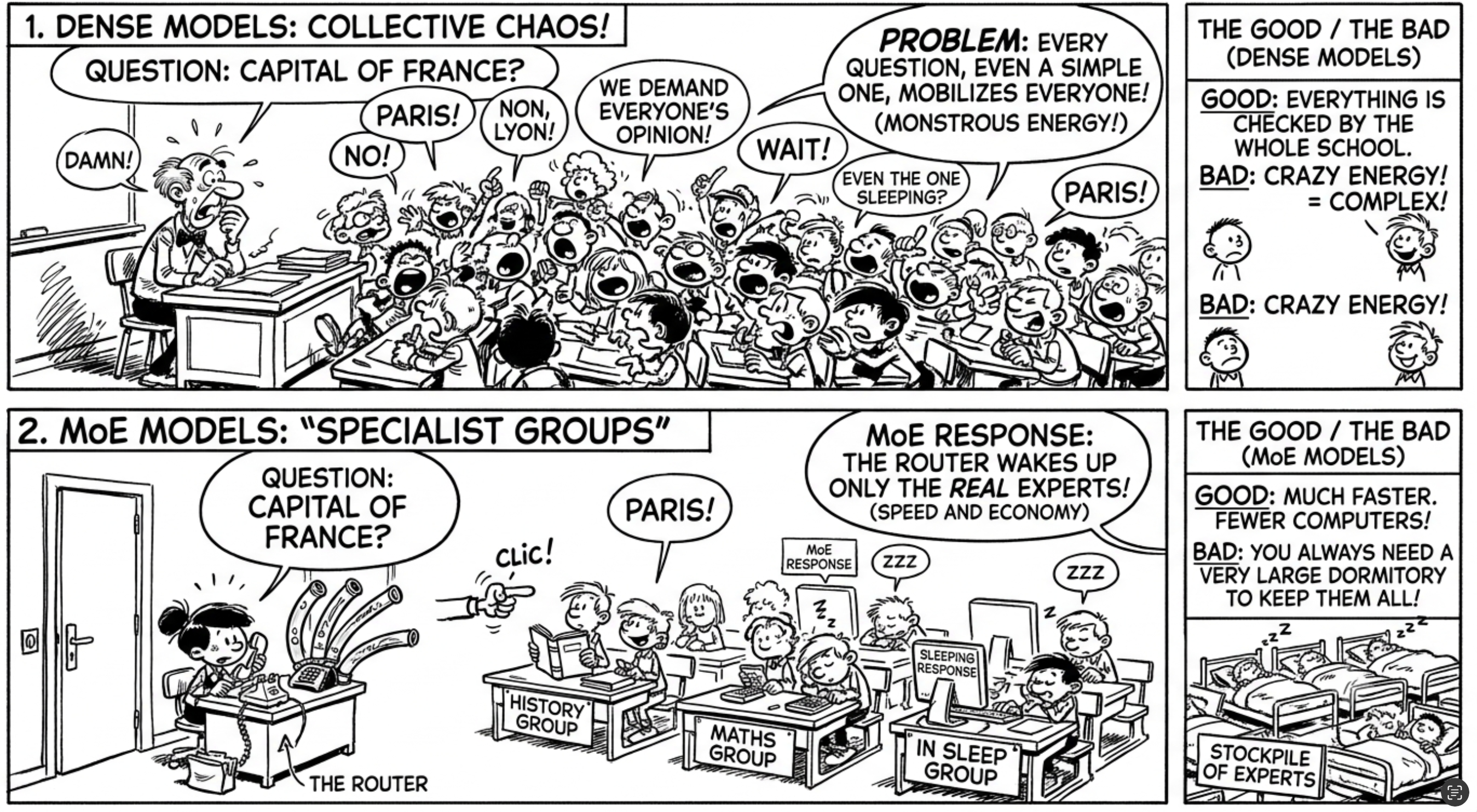
Picture a rickety carnival tent, a hive of performers each bragging about a specialty act. One juggles flaming torches, another walks a tightrope over a pit of snakes, a contortionist folds herself into a pretzel. The ringmaster (that’s your Mixture‑of‑Experts, or MoE, in a nutshell) shouts, “Pick the act that best fits the trick,” and the audience watches pure, unfiltered talent explode.
In the language‑model world, each expert is a sub‑network—usually a feed‑forward block or a transformer slice—trained to master a slice of the data distribution. When a prompt arrives, a learned router decides which experts should flex their neurons, and the rest sit on the sidelines sipping cheap beer. The result? A model that can scale to billions of parameters without the computational cost of firing every single neuron for every token.
Bottom line: MoE lets us build huge brains and spend only a fraction of the energy on each thought.
2. Why the Frenzy? The Sweet‑Spot Between Size and Speed #
2.1. Parameter‑Count vs. Compute‑Count
Traditional monolithic LLMs are like a bulldozer that smashes everything in its path. You scale them up, you get better performance—until the electricity bill and latency start looking like a bad breakup. MoE, however, decouples parameter count (the brain’s raw knowledge) from compute count (how many neurons actually fire).
Result:
- Hundreds of billions of parameters in the model’s latent pool.
- Only a few million (or billion) activated per token, keeping latency in check.
2.2. Specialization Without Over‑fitting
Because each expert sees only a slice of the data, they become specialists—the way a jazz saxophonist hones improvisation on one chord progression. This prevents the model from “trying to be everything for everyone,” a classic cause of catastrophic forgetting.
2.3. Economic Incentives
Cloud‑GPU pricing is still measured in core‑seconds. MoE lets you rent the same price bracket but get the performance of a model several magnitudes larger. The result is a sweet spot that looks like a unicorn: massive knowledge with affordable inference.
3. The Dark Side of the MoE Circus #
No good story is complete without a little danger.
| Pitfall | Why It Bleeds |
|---|---|
| Router Instability | An ill‑trained routing network can send every prompt to the same expert, turning the circus into a one‑man show. |
| Load‑Balancing Nightmares | Over‑activating a handful of experts creates hot‑spots, spiking latency and GPU memory usage. |
| Training Instability | Gradient updates must be carefully sharded across experts, else you’ll end up with a model that forgets how to read as fast as it can write. |
| Interpretability Woes | When you have a hundred experts, knowing which one decided why becomes a Sherlock‑level mystery. |
The community is already patching these holes with auxiliary losses (to enforce balanced routing), capacity factors, and expert dropout—but the battle is far from over.
4. Real‑World MoE Deployments (A Gonzo Tour) #
- Google’s Switch‑Transformer (2021) – The first headline‑grabbing MoE that shoved 1.6 T parameters into a model that still answered queries in milliseconds. The router was an ultra‑efficient top‑1 routing mechanism over 2048 experts—sending each token to just one specialist at a time with razor‑sharp precision.
- Google Research’s GLaM (2022) – A 1.2 T‑parameter beast with 64 total experts per layer, activating only 2 per token. Used for multilingual and language tasks, it showed that MoE can natively speak dozens of tongues using roughly one‑third the energy of dense giants.
- OpenAI’s GPT‑4 Architecture – Industry reports and research breakdowns revealed that modern production powerhouses blend MoE ideas directly into multi‑expert architectures, deploying routed sub‑networks to serve massive capabilities without melting down datacenter power grids.
5. How to Build Your Own MoE Lab (No Lab Coat Required) #
TL;DR: Use transformers or custom PyTorch (torch.nn.ModuleList) and feed the router a soft top‑k selection.
- Define Experts – Stack a list of identical transformer feed‑forward blocks.
- Add a Router – A lightweight MLP that maps the input embedding to a logit for each expert. Apply a top‑k (usually 1 or 2) and a softmax to get gating weights.
- Sparse Activation – Multiply the gating weights by the selected expert outputs and sum them up.
- Balanced Loss – Append an auxiliary term penalizing expert usage variance (entropy or load‑balancing loss).
- Training – Use Mixed Precision (FP16/ BF16) and ZeRO‑stage optimizations to keep GPU memory sane.
A minimal code snippet (PyTorch) is posted on the repo /samples/moe_demo.py – feel free to swing by, fork, and throw a bottle of bourbon at the router if it misbehaves.
6. The Verdict: Is MoE the Future of LLMs or Just Another Flashy Trick? #
The data says yes. When you stare at a 10‑B‑parameter dense model and a 100‑B‑parameter MoE with comparable latency, the psychopath inside you whispers, “Why settle for the boring old dinosaur when you can have a circus of specialized beasts?”
But remember: complexity is a double‑edged sword. The more moving parts you have, the higher the chance something will go boom when you least expect it.
“When the going gets weird, the weird turn on the switch‑router and keep the party rolling.”
So, fellow AI wranglers, strap on your leather jacket, keep the router calibrated, and let the experts do their thing. The future is sparse, selective, and wildly spectacular—just the way we like it.
Summary
- MoE = Sparse activation of massive parameter pools.
- Pros: Scale, specialization, cost‑efficiency.
- Cons: Routing stability, load‑balancing, interpretability.
- Implement: Use top‑k gating, auxiliary load‑balancing loss, mixed‑precision training.
- Bottom Line: MoE isn’t a gimmick; it’s the revolution that lets us keep the circus running without burning the whole town down.
Stay weird, stay curious, and keep feeding those experts.
Here are direct URLs to key research papers and reference materials :
- Switch Transformer Paper (Google, 2021):
- GLaM Model Paper (Google Research, 2022):
arXiv:2112.06905 - GLaM: Efficient Scaling of Language Models with Mixture-of-Experts
- Hugging Face MoE Technical Deep-Dive:
Comments & Ratings
#
Loading comments...